S-Beams (American Standard I-Beams): AISC Sizes & Weights
Hot-rolled S-Beams from S3×5.7 to S24×121 in ASTM A36 or A572 Grade 50, for monorail and hoist beams and for matching existing steel, cut and drilled to your drawings.
At a glance
- Sizes
- 28 AISC designations, S3 to S24
- Flange
- Sloped inner face, about 16-2/3%
- Grades
- A36, A572 Gr. 50
- Alternatives
- Nearest W-Beam, for engineer review
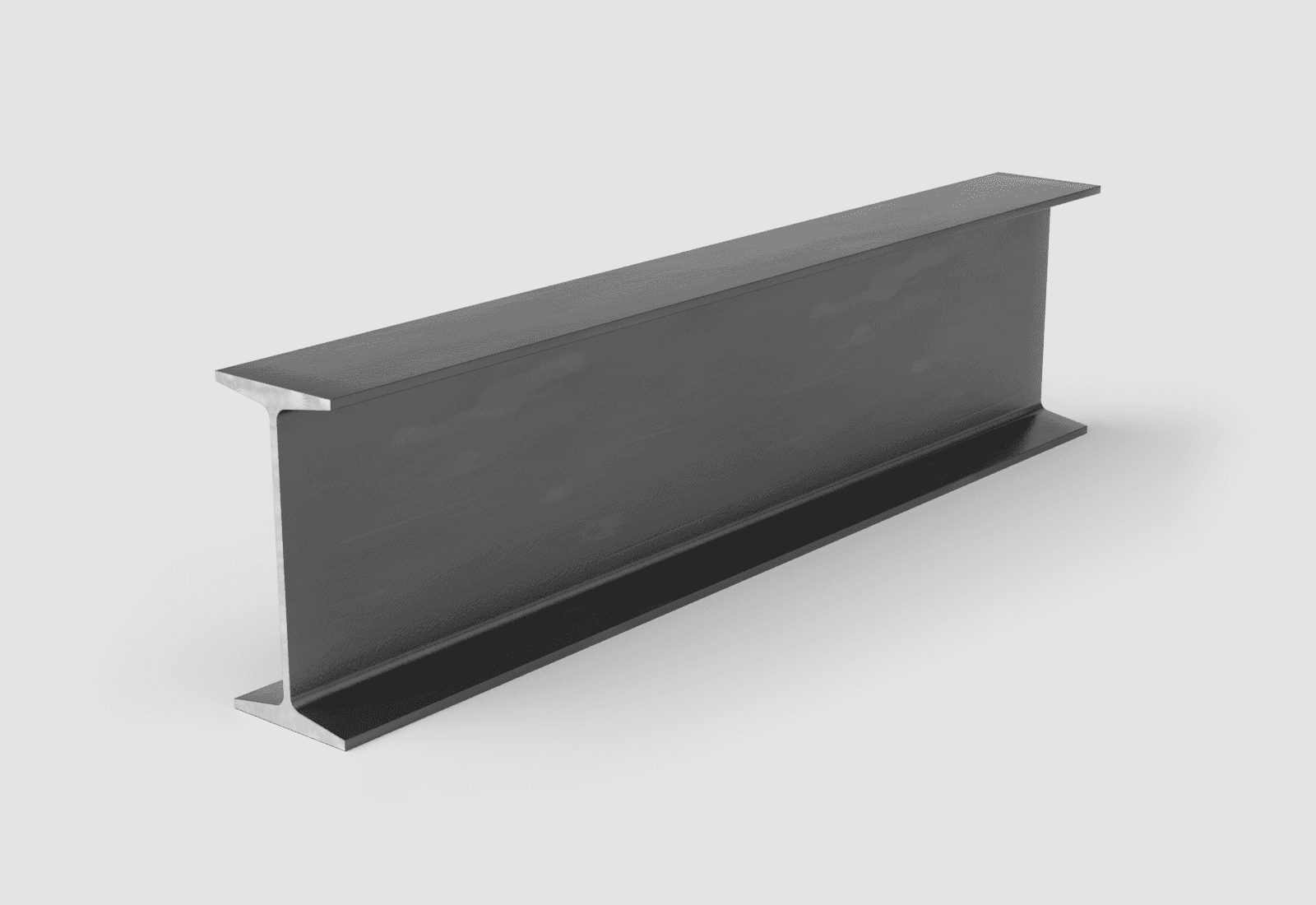
S-Beams are the American Standard beams in the AISC tables, also sold as standard I-beams. AISC lists 28 S designations from 3 in. to 24 in. nominal depth, all with narrow flanges whose inner faces taper toward the toe. Junior beams, the light M designations, are a separate family.
Mona Steel supplies S-Beams to fabricators, erectors, general contractors and OEMs. Each order ships with mill test reports that carry the heat numbers for your QA/QC file.
S-Beam sizes and weights
The table lists all 28 AISC S-Beam designations Mona Steel supplies and quotes, S3×5.7 to S24×121. Quote one size from its row, or check several rows to build a single quote list.
| Size | Weight (lb/ft) | Depth d (in.) | Flange width bf (in.) | Web tw (in.) | Flange tf (in.) | Quote |
|---|---|---|---|---|---|---|
| S3 | ||||||
| S3×5.7 | 5.7 | 3.00 | 2.33 | 0.170 | 0.260 | Quote |
| S3×7.5 | 7.5 | 3.00 | 2.51 | 0.349 | 0.260 | Quote |
| S4 | ||||||
| S4×7.7 | 7.7 | 4.00 | 2.66 | 0.193 | 0.293 | Quote |
| S4×9.5 | 9.5 | 4.00 | 2.80 | 0.326 | 0.293 | Quote |
| S5 | ||||||
| S5×10 | 10 | 5.00 | 3.00 | 0.214 | 0.326 | Quote |
| S6 | ||||||
| S6×12.5 | 12.5 | 6.00 | 3.33 | 0.232 | 0.359 | Quote |
| S6×17.25 | 17.25 | 6.00 | 3.57 | 0.465 | 0.359 | Quote |
| S8 | ||||||
| S8×18.4 | 18.4 | 8.00 | 4.00 | 0.271 | 0.425 | Quote |
| S8×23 | 23 | 8.00 | 4.17 | 0.441 | 0.425 | Quote |
| S10 | ||||||
| S10×25.4 | 25.4 | 10.0 | 4.66 | 0.311 | 0.491 | Quote |
| S10×35 | 35 | 10.0 | 4.94 | 0.594 | 0.491 | Quote |
| S12 | ||||||
| S12×31.8 | 31.8 | 12.0 | 5.00 | 0.350 | 0.544 | Quote |
| S12×35 | 35 | 12.0 | 5.08 | 0.428 | 0.544 | Quote |
| S12×40.8 | 40.8 | 12.0 | 5.25 | 0.462 | 0.659 | Quote |
| S12×50 | 50 | 12.0 | 5.48 | 0.687 | 0.659 | Quote |
| S15 | ||||||
| S15×42.9 | 42.9 | 15.0 | 5.50 | 0.411 | 0.622 | Quote |
| S15×50 | 50 | 15.0 | 5.64 | 0.550 | 0.622 | Quote |
| S18 | ||||||
| S18×54.7 | 54.7 | 18.0 | 6.00 | 0.461 | 0.691 | Quote |
| S18×70 | 70 | 18.0 | 6.25 | 0.711 | 0.691 | Quote |
| S20 | ||||||
| S20×66 | 66 | 20.0 | 6.26 | 0.505 | 0.795 | Quote |
| S20×75 | 75 | 20.0 | 6.39 | 0.635 | 0.795 | Quote |
| S20×86 | 86 | 20.3 | 7.06 | 0.660 | 0.920 | Quote |
| S20×96 | 96 | 20.3 | 7.20 | 0.800 | 0.920 | Quote |
| S24 | ||||||
| S24×80 | 80 | 24.0 | 7.00 | 0.500 | 0.870 | Quote |
| S24×90 | 90 | 24.0 | 7.13 | 0.625 | 0.870 | Quote |
| S24×100 | 100 | 24.0 | 7.25 | 0.745 | 0.870 | Quote |
| S24×106 | 106 | 24.5 | 7.87 | 0.620 | 1.09 | Quote |
| S24×121 | 121 | 24.5 | 8.05 | 0.800 | 1.09 | Quote |
Source: AISC Shapes Database v16.0. Weights are nominal lb/ft, and tf is the average thickness of the sloped flange. Dimensions are for reference only; confirm sizes and section properties with your engineer. The quote confirms availability, lengths and lead time.
S-Beam vs. W-Beam
Both are hot-rolled I-shaped beams, and the difference is in the flanges. A W-Beam (wide flange beam) has wide flanges with parallel faces. An S-Beam has narrower flanges whose inner faces slope at about 16-2/3%, a rise of 2 in 12, so each flange is thicker at the web than at the toe.
At about the same weight and depth, an S10×25.4 has a 4.66 in. flange width and a 0.311 in. web thickness. A W10×26 has a 5.77 in. flange width and a 0.26 in. web thickness. W-Beams are the standard section for most new steel framing, and S-Beams stay on drawings where the narrow, sloped flange or an existing structure calls for one.
The slope matters at bolted connections. A nut or bolt head on the inner flange face sits on a 1:6 slope, steeper than the 1:20 the RCSC Specification for Structural Joints allows without a beveled washer. Show the beveled washers on the shop drawings and the field bolt list.
Where S-Beams fit
Your engineer sizes the member. On a monorail, the engineer sizes the beam for the hoist capacity, the hoist supplier confirms the trolley fits the flange, and we supply the section on the drawing.
Typical S-Beam work includes:
- Monorail, hoist and trolley beams
- Renovation and retrofit work, matching the depth and flange of an existing member
- Machine bases and equipment supports
- Light framing and miscellaneous steel
Availability and W-Beam alternatives
Some S sizes are rolled infrequently, so we confirm each size on the quote before you order.
When a size is hard to source, the quote can show the nearest W-Beam next to it for your engineer to review. A W-Beam of similar depth and weight has a wider flange, parallel flange faces and different section properties, so the swap can change connections, clearances and trolley fit.
For an older member that is not in the current AISC list, send its measured depth, flange width and web and flange thickness. We will quote the nearest current S-Beam or W-Beam for your engineer to review.
Grades and processing
S-Beams are quoted in ASTM A36 (36 ksi minimum yield) or ASTM A572 Grade 50 (50 ksi minimum yield), with other grades on request. Dimensions and tolerances follow ASTM A6.
Random lengths are available, or S-Beams can be processed to your drawings before they ship. Our detailing team can draw the shop drawings from your structural set if you need them.
- Cut to length or mitered
- Holes drilled or punched; slots and copes laser or plasma cut
- Hot-dip galvanized per ASTM A123 on request
- Bundled and tagged with the piece marks on your drawings
Delivery
S-Beams travel quoted per load, delivered across California or shipped to job sites in Texas, Arizona, Nevada and nationwide. Each load is tagged and sequenced to suit your erector’s crew, whether it goes to your shop, the erector or the job site.
S-Beams FAQ
S-Beam vs. W-Beam: what is the difference?
An S-Beam (American Standard beam) has narrow flanges whose inner faces slope at about 16-2/3%. A W-Beam (wide flange beam) has wider flanges with parallel faces. At about 12 in. deep and 30 lb/ft, an S12×31.8 flange is 5 in. wide and a W12×30 flange is 6.52 in. wide.
What does S10×25.4 mean?
S10×25.4 is an S-Beam (American Standard beam) with a 10 in. nominal depth that weighs 25.4 lb/ft. The heavier S10×35 is also 10 in. deep with the same 0.491 in. average flange thickness, but its web is 0.594 in. thick against 0.311 in. and its flange 4.94 in. wide against 4.66 in.
Do S-Beam flanges need beveled washers?
Yes, where a bolt passes through the flange. A beveled washer on the sloped inner face gives the nut or bolt head a square seat, and ASTM F436 beveled washers for American Standard beams are made to the same 1:6 slope. Connection details stay with your engineer.
When is an S-Beam used instead of a W-Beam?
When the drawings call for one: monorail, hoist and trolley beams, matching existing S-Beams in renovation work, machine bases and light framing. For new building framing, W-Beams to ASTM A992 are the usual choice.
What grade are S-Beams?
ASTM A36 or A572 Grade 50, whichever your drawings or project specification call for, with other grades on request. The mill test reports show the grade by heat number.
Can a W-Beam be substituted for an S-Beam?
Sometimes, with your engineer’s approval. The engineer checks section properties and connections, and on a monorail the hoist supplier confirms the trolley fits the wider, parallel flange. We can show the nearest W-Beam on the quote next to the S size.
Request a quote
Request pricing on S-Beams
Tick the sizes you need in the table, or send your cut list or takeoff. We come back with an itemized quote, mill test reports included with the order.
- DXF
- DWG
- STEP
- XLS/CSV