Hot-Rolled Steel Channel: C & MC Sizes, Weights & Grades
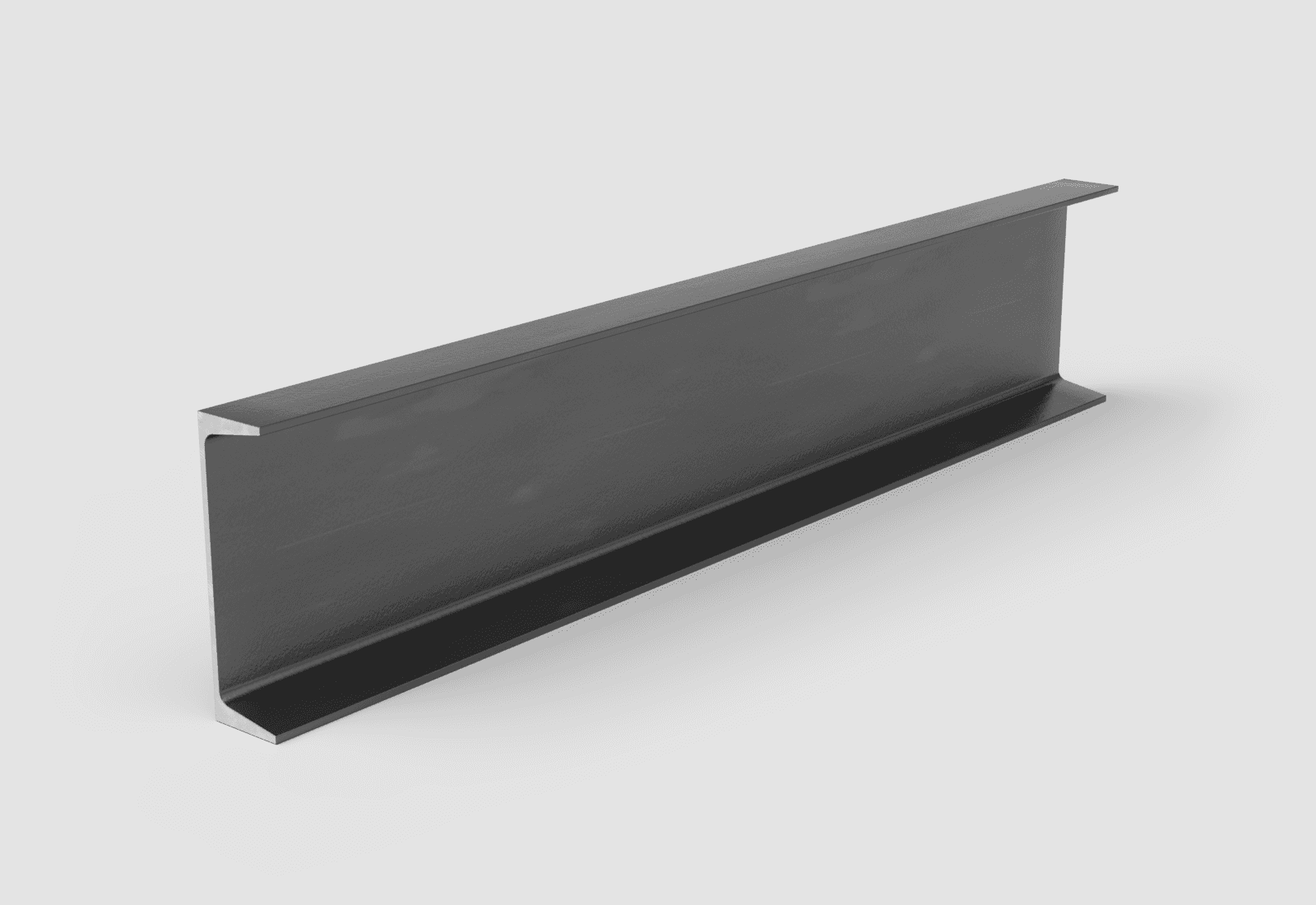
American Standard (C) and miscellaneous (MC) steel channel from 3 to 18 in. deep in A36 and A572 Grade 50, for lintels, stair stringers, framing and truck and trailer frames.
At a glance
- Sizes
- 32 C and 40 MC designations
- Range
- 3 to 18 in. deep, 3.5 to 58 lb/ft
- Grades
- A36, A572 Gr. 50
- Processing
- Cut, drilled, punched, coped, galvanized
Mona Steel supplies hot-rolled steel channel to fabricators, contractors, erectors and OEMs and quotes every standard AISC C and MC designation: 32 C sections from C3×3.5 to C15×50 and 40 MC sections from MC3×7.1 to MC18×58.
A channel has a flat back with both flanges on one side, so the web sits flush against a wall, a slab edge or another member and bolts or welds straight to it. Each shipment carries mill test reports, traceable by heat number.
Channel sizes and weights
The size tables list the standard AISC C and MC designations Mona Steel supplies and quotes, with depth, flange width, web thickness, average flange thickness and weight per foot. Tick the sizes you need to build one quote list, or use “Quote” on any row.
C channels (American Standard)
| Size | Weight (lb/ft) | Depth d (in.) | Flange width bf (in.) | Web tw (in.) | Flange tf avg. (in.) | Quote |
|---|---|---|---|---|---|---|
| C3×3.5 | 3.5 | 3.00 | 1.37 | 0.132 | 0.273 | Quote |
| C3×4.1 | 4.1 | 3.00 | 1.41 | 0.170 | 0.273 | Quote |
| C3×5 | 5 | 3.00 | 1.50 | 0.258 | 0.273 | Quote |
| C3×6 | 6 | 3.00 | 1.60 | 0.356 | 0.273 | Quote |
| C4×4.5 | 4.5 | 4.00 | 1.52 | 0.125 | 0.296 | Quote |
| C4×5.4 | 5.4 | 4.00 | 1.58 | 0.184 | 0.296 | Quote |
| C4×6.25 | 6.25 | 4.00 | 1.65 | 0.247 | 0.296 | Quote |
| C4×7.25 | 7.25 | 4.00 | 1.72 | 0.321 | 0.296 | Quote |
| C5×6.7 | 6.7 | 5.00 | 1.75 | 0.190 | 0.320 | Quote |
| C5×9 | 9 | 5.00 | 1.89 | 0.325 | 0.320 | Quote |
| C6×8.2 | 8.2 | 6.00 | 1.92 | 0.200 | 0.343 | Quote |
| C6×10.5 | 10.5 | 6.00 | 2.03 | 0.314 | 0.343 | Quote |
| C6×13 | 13 | 6.00 | 2.16 | 0.437 | 0.343 | Quote |
| C7×9.8 | 9.8 | 7.00 | 2.09 | 0.210 | 0.366 | Quote |
| C7×12.25 | 12.25 | 7.00 | 2.19 | 0.314 | 0.366 | Quote |
| C7×14.75 | 14.75 | 7.00 | 2.30 | 0.419 | 0.366 | Quote |
| C8×11.5 | 11.5 | 8.00 | 2.26 | 0.220 | 0.390 | Quote |
| C8×13.75 | 13.75 | 8.00 | 2.34 | 0.303 | 0.390 | Quote |
| C8×18.75 | 18.75 | 8.00 | 2.53 | 0.487 | 0.390 | Quote |
| C9×13.4 | 13.4 | 9.00 | 2.43 | 0.233 | 0.413 | Quote |
| C9×15 | 15 | 9.00 | 2.49 | 0.285 | 0.413 | Quote |
| C9×20 | 20 | 9.00 | 2.65 | 0.448 | 0.413 | Quote |
| C10×15.3 | 15.3 | 10.0 | 2.60 | 0.240 | 0.436 | Quote |
| C10×20 | 20 | 10.0 | 2.74 | 0.379 | 0.436 | Quote |
| C10×25 | 25 | 10.0 | 2.89 | 0.526 | 0.436 | Quote |
| C10×30 | 30 | 10.0 | 3.03 | 0.673 | 0.436 | Quote |
| C12×20.7 | 20.7 | 12.0 | 2.94 | 0.282 | 0.501 | Quote |
| C12×25 | 25 | 12.0 | 3.05 | 0.387 | 0.501 | Quote |
| C12×30 | 30 | 12.0 | 3.17 | 0.510 | 0.501 | Quote |
| C15×33.9 | 33.9 | 15.0 | 3.40 | 0.400 | 0.650 | Quote |
| C15×40 | 40 | 15.0 | 3.52 | 0.520 | 0.650 | Quote |
| C15×50 | 50 | 15.0 | 3.72 | 0.716 | 0.650 | Quote |
MC channels (miscellaneous)
| Size | Weight (lb/ft) | Depth d (in.) | Flange width bf (in.) | Web tw (in.) | Flange tf avg. (in.) | Quote |
|---|---|---|---|---|---|---|
| MC3×7.1 | 7.1 | 3.00 | 1.94 | 0.312 | 0.351 | Quote |
| MC4×13.8 | 13.8 | 4.00 | 2.50 | 0.500 | 0.500 | Quote |
| MC6×6.5 | 6.5 | 6.00 | 1.85 | 0.155 | 0.291 | Quote |
| MC6×7 | 7 | 6.00 | 1.88 | 0.179 | 0.291 | Quote |
| MC6×12 | 12 | 6.00 | 2.50 | 0.310 | 0.375 | Quote |
| MC6×15.1 | 15.1 | 6.00 | 2.94 | 0.316 | 0.475 | Quote |
| MC6×15.3 | 15.3 | 6.00 | 3.50 | 0.340 | 0.385 | Quote |
| MC6×16.3 | 16.3 | 6.00 | 3.00 | 0.375 | 0.475 | Quote |
| MC6×18 | 18 | 6.00 | 3.50 | 0.379 | 0.475 | Quote |
| MC7×19.1 | 19.1 | 7.00 | 3.45 | 0.352 | 0.500 | Quote |
| MC7×22.7 | 22.7 | 7.00 | 3.60 | 0.503 | 0.500 | Quote |
| MC8×8.5 | 8.5 | 8.00 | 1.87 | 0.179 | 0.311 | Quote |
| MC8×18.7 | 18.7 | 8.00 | 2.98 | 0.353 | 0.500 | Quote |
| MC8×20 | 20 | 8.00 | 3.03 | 0.400 | 0.500 | Quote |
| MC8×21.4 | 21.4 | 8.00 | 3.45 | 0.375 | 0.525 | Quote |
| MC8×22.8 | 22.8 | 8.00 | 3.50 | 0.427 | 0.525 | Quote |
| MC9×23.9 | 23.9 | 9.00 | 3.45 | 0.400 | 0.550 | Quote |
| MC9×25.4 | 25.4 | 9.00 | 3.50 | 0.450 | 0.550 | Quote |
| MC10×6.5 | 6.5 | 10.0 | 1.17 | 0.152 | 0.202 | Quote |
| MC10×8.4 | 8.4 | 10.0 | 1.50 | 0.170 | 0.280 | Quote |
| MC10×22 | 22 | 10.0 | 3.32 | 0.290 | 0.575 | Quote |
| MC10×25 | 25 | 10.0 | 3.41 | 0.380 | 0.575 | Quote |
| MC10×28.5 | 28.5 | 10.0 | 3.95 | 0.425 | 0.575 | Quote |
| MC10×33.6 | 33.6 | 10.0 | 4.10 | 0.575 | 0.575 | Quote |
| MC10×41.1 | 41.1 | 10.0 | 4.32 | 0.796 | 0.575 | Quote |
| MC12×10.6 | 10.6 | 12.0 | 1.50 | 0.190 | 0.309 | Quote |
| MC12×14.3 | 14.3 | 12.0 | 2.12 | 0.250 | 0.313 | Quote |
| MC12×31 | 31 | 12.0 | 3.67 | 0.370 | 0.700 | Quote |
| MC12×35 | 35 | 12.0 | 3.77 | 0.465 | 0.700 | Quote |
| MC12×40 | 40 | 12.0 | 3.89 | 0.590 | 0.700 | Quote |
| MC12×45 | 45 | 12.0 | 4.01 | 0.710 | 0.700 | Quote |
| MC12×50 | 50 | 12.0 | 4.14 | 0.835 | 0.700 | Quote |
| MC13×31.8 | 31.8 | 13.0 | 4.00 | 0.375 | 0.610 | Quote |
| MC13×35 | 35 | 13.0 | 4.07 | 0.447 | 0.610 | Quote |
| MC13×40 | 40 | 13.0 | 4.19 | 0.560 | 0.610 | Quote |
| MC13×50 | 50 | 13.0 | 4.41 | 0.787 | 0.610 | Quote |
| MC18×42.7 | 42.7 | 18.0 | 3.95 | 0.450 | 0.625 | Quote |
| MC18×45.8 | 45.8 | 18.0 | 4.00 | 0.500 | 0.625 | Quote |
| MC18×51.9 | 51.9 | 18.0 | 4.10 | 0.600 | 0.625 | Quote |
| MC18×58 | 58 | 18.0 | 4.20 | 0.700 | 0.625 | Quote |
Source: AISC Shapes Database v16.0. Weights are nominal lb/ft and dimensions are for reference; review the section with your engineer. We confirm availability, lengths and lead time when we quote.
C vs. MC channel
C is the American Standard channel. Its inner flange faces slope at 16-2/3%, the same taper as an S-Beam, so the tables give an average flange thickness. AISC lists 32 C sections in ten depths from 3 to 15 in.
MC is the miscellaneous channel, also called ship channel or car and ship channel. AISC lists 40 MC sections from 3 to 18 in. deep, including 13 and 18 in. depths that C does not cover. At 12 in., C runs from C12×20.7 to C12×30 with flanges 2.94 to 3.17 in. wide, while MC runs from MC12×10.6 with a 1.5 in. flange to MC12×50 with a 4.14 in. flange.
Order by the full designation. C10×25 and MC10×25 are both 10 in. deep and 25 lb/ft, but the C has a 2.89 in. flange and the MC a 3.41 in. flange. If a size on your drawing isn’t available when you order, ask us to quote the nearest alternative for your engineer to review.
Hot-rolled channel or cold-formed C-channel?
This page covers hot-rolled structural channel: C and MC sections with dimensions and tolerances per ASTM A6 and webs from 0.125 to 0.835 in. thick. Drawings call it out by AISC designation, such as C6×8.2 or MC8×22.8.
Cold-formed C-channel is a different product. It is roll-formed from flat sheet or coil, specified by gauge or thickness, lipped or unlipped and often pre-galvanized, and used for purlins, studs, racking and solar rails. For roll-formed C-channel and C-purlins from 20 gauge to ¼ in., see our Cold-Formed Profiles page.
How to read C8×11.5 and MC12×10.6
C or MC names the family; then come the depth in inches and the nominal weight in pounds per foot. C8×11.5 is an American Standard channel 8 in. deep at 11.5 lb/ft. MC12×10.6 is a miscellaneous channel 12 in. deep at 10.6 lb/ft.
Within one C depth the average flange thickness stays the same; the heavier sections get a thicker web and a slightly wider flange. C8×11.5 has a 0.22 in. web and a 2.26 in. flange, and C8×18.75 has a 0.487 in. web and a 2.53 in. flange.
Where C and MC channel is used
Typical uses for C and MC channel:
- Lintels over openings in masonry and framed walls
- Stair stringers
- Framing and headers around floor and roof openings
- Equipment supports, dunnage and platforms
- Truck and trailer frames and crossmembers, often in MC sections
Grades: A36 and A572 Grade 50
Channel is quoted in ASTM A36, at 36 ksi minimum yield, or in ASTM A572 Grade 50, at 50 ksi; other grades are available on request. Channel often meets both grades in a single heat; the mill test report shows it, and our A36 vs. A572 Grade 50 guide explains the two grades.
Processing and delivery
Send a cut list, a takeoff or your drawings. With only the contract set in hand, our detailing team can prepare shop drawings and cut lists first.
Delivery is quoted per load, across California and to job sites in Texas, Arizona, Nevada and nationwide.
Order random lengths, or save shop hours and crane time with channel processed before it ships:
- Mitered or cut square to length
- Drilled, punched and coped
- Slots, holes and copes laser or plasma cut
- Hot-dip galvanized to ASTM A123
- Bundled and labeled with piece-mark tags
Steel Channels FAQ
What is the difference between C and MC channel?
C is the American Standard channel, with sloped inner flange faces, in 32 sizes from 3 to 15 in. deep. MC is the miscellaneous channel, also called ship channel, in 40 sizes from 3 to 18 in. deep. Sections of almost the same weight still differ: C8×18.75 has a 2.53 in. flange and MC8×18.7 a 2.98 in. flange, so order by the full designation.
How much does steel channel weigh per foot?
From 3.5 lb/ft for C3×3.5 to 58 lb/ft for MC18×58, with the nominal weight of every size in the table. Multiply lb/ft by length: 10 ft of C8×11.5 weighs 115 lb.
Hot-rolled C channel or cold-formed C-channel: which do I need?
If the drawing gives an AISC designation such as C5×6.7 or MC6×12, you need hot-rolled channel. If it gives a gauge or thickness, a lip, or a purlin or stud depth, you need roll-formed C-channel, which is on our Cold-Formed Profiles page.
Why do C channels have sloped flanges?
The taper is part of the American Standard profile that C channels share with S-Beams: the inner flange faces slope at 16-2/3%, so tables give an average flange thickness. High-strength bolts through that flange call for ASTM F436 beveled washers, as the S-Beams page explains.
What grade is structural channel?
Hot-rolled channel is quoted in ASTM A36 or A572 Grade 50; ask for other grades on the quote. The mill test report shipped with every order shows the grade, including heats that meet both.
Request a quote
Request pricing on steel channels
Tick the sizes you need in the table, or send your cut list or takeoff. We come back with an itemized quote, mill test reports included with the order.
- DXF
- DWG
- STEP
- XLS/CSV