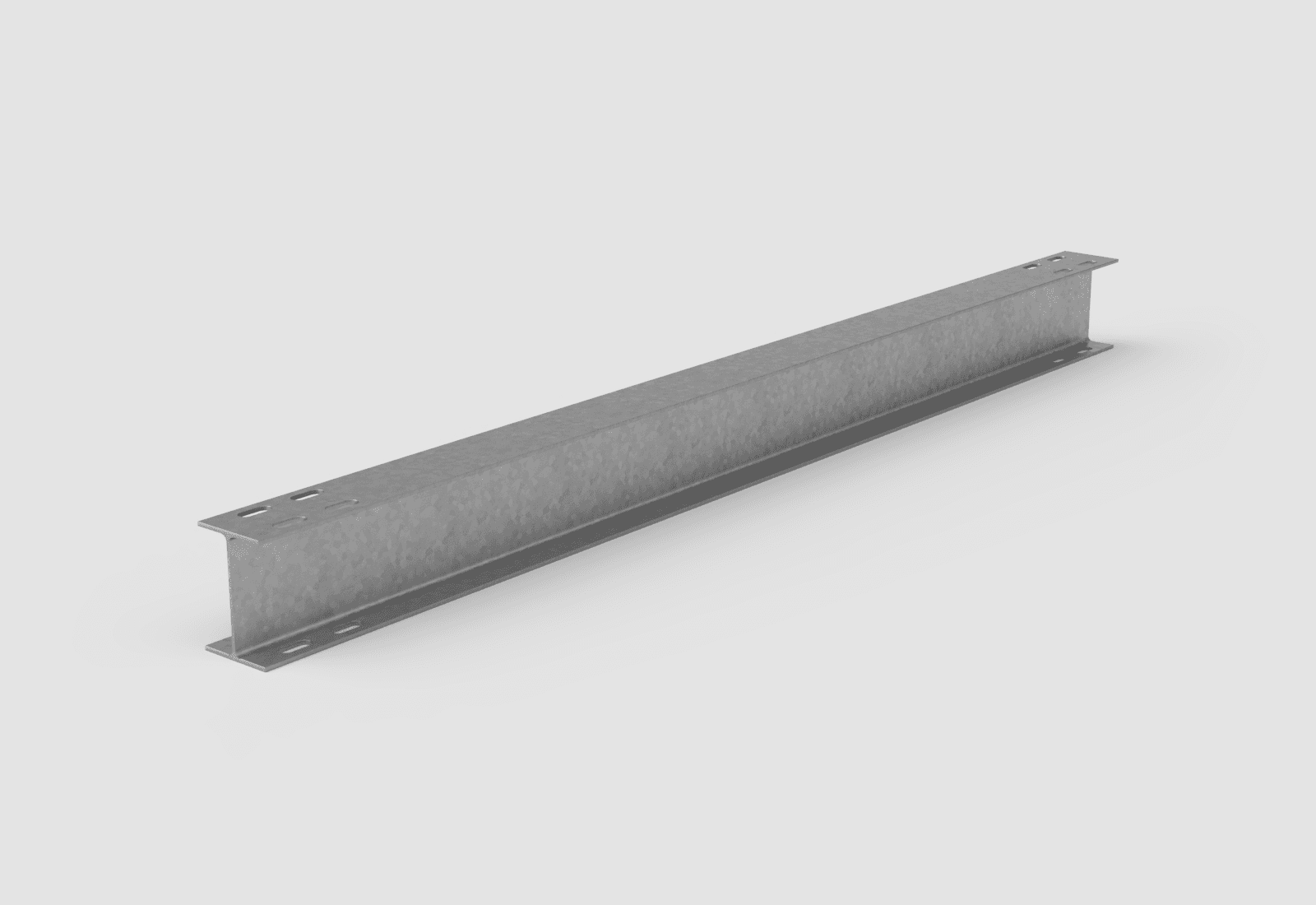
Mona Steel LLC, headquartered in Anaheim, California, supplies driven solar piles for utility-scale projects across the United States: hot-rolled W-Beam (wide flange) piles from W6×8.5 to W8×35, and roll-formed C-piles, U-piles and sigma piles. Piles are cut to the lengths in the pier table, punched or slotted to the racking manufacturer’s drawings, hot-dip galvanized to ASTM A123 or the project specification, bundled and labeled by block, and delivered in releases sequenced to the pile-driving schedule.
We quote single projects and multi-project programs for EPCs, developers, racking and tracker companies and pile-driving contractors, with the purlins, rails, brackets and splice plates on the same purchase order when you need them.
W-Beam solar piles (W6 and W8)
W-Beam piles, also called wide flange piles, I-beam posts or ramming posts, carry most single-axis tracker rows and many fixed-tilt tables, and suit higher loads and harder driving. We supply them in ASTM A572 Grade 50 and A992, with A588 and A709 on request, cut to length, punched or slotted to the pier drawings, and hot-dip galvanized after fabrication so the holes and cut ends are coated too.
| Section | lb/ft | kg/m | Depth (in.) | Flange width (in.) | Web / flange (in.) | A123 minimum, web / flange |
|---|---|---|---|---|---|---|
| W6×8.5 | 8.5 | 12.6 | 5.83 | 3.94 | 0.170 / 0.195 | 3.0 mil |
| W6×9 | 9 | 13.4 | 5.90 | 3.94 | 0.170 / 0.215 | 3.0 mil |
| W6×12 | 12 | 17.9 | 6.03 | 4.00 | 0.230 / 0.280 | 3.0 / 3.9 mil |
| W6×15 | 15 | 22.3 | 5.99 | 5.99 | 0.230 / 0.260 | 3.0 / 3.9 mil |
| W6×16 | 16 | 23.8 | 6.28 | 4.03 | 0.260 / 0.405 | 3.9 mil |
| W6×20 | 20 | 29.8 | 6.20 | 6.02 | 0.260 / 0.365 | 3.9 mil |
| W8×10 | 10 | 14.9 | 7.89 | 3.94 | 0.170 / 0.205 | 3.0 mil |
| W8×13 | 13 | 19.3 | 7.99 | 4.00 | 0.230 / 0.255 | 3.0 / 3.9 mil |
| W8×15 | 15 | 22.3 | 8.11 | 4.02 | 0.245 / 0.315 | 3.0 / 3.9 mil |
| W8×18 | 18 | 26.8 | 8.14 | 5.25 | 0.230 / 0.330 | 3.0 / 3.9 mil |
Nominal AISC dimensions. A123 minimum coating by steel thickness: 3.0 mil (grade 75) under ¼ in., 3.9 mil (grade 100) at ¼ in. and up. Lighter W6 sections rolled outside the AISC list, such as W6×7, are quoted on the mill’s dimensions.
Solar pile weight chart & calculator Every W-Beam size, W4 to W44
C-piles and sigma piles
C-piles and sigma piles are cold-formed sections roll formed from coil, punched and slotted in line and cut to length in one pass, which makes them efficient in the volumes a utility-scale project needs. The open section takes rails and brackets directly, and a sigma pile’s folded web adds stiffness for the same steel thickness. Both come perforated for adjustable bracket heights on uneven ground, or plain for fixed attachment heights.
- Coatings: pre-galvanized or zinc-magnesium coil, or hot-dip galvanized after forming per ASTM A123 when the cut ends and holes must be coated too
- Sections developed or matched to your racking drawings, with tooling and first articles before the production run
U-piles
U-piles offer an open section that drives efficiently and provides flat faces for bracket attachment. Like C-piles, they are available perforated or non-perforated and can be produced in custom lengths and gauges.
| C-pile | U-pile | W-Beam pile | |
|---|---|---|---|
| Section | Cold-formed C-section, roll formed | Open U-section | Hot-rolled W-Beam (wide flange) |
| Typical use | Tracker and fixed-tilt systems | Brackets on multiple faces | Single-axis trackers and higher-load designs |
| Perforation | Perforated or non-perforated | Perforated or non-perforated | Custom slotted or perforated |
| Grades | Cold-formed high-strength steel | Cold-formed high-strength steel | ASTM A572 Gr. 50, A992, A588, A709 |
| Finish | Hot-dip galvanized per ASTM A123 | Hot-dip galvanized per ASTM A123 | Hot-dip galvanized per ASTM A123 |
| What you send | Pile drawings, quantity, coating, location and schedule | Pile drawings, quantity, coating, location and schedule | Pile drawings, quantity, coating, location and schedule |
C-piles
- Section
- Cold-formed C-section, roll formed
- Typical use
- Tracker and fixed-tilt systems
- Perforation
- Perforated or non-perforated
- Grades
- Cold-formed high-strength steel
- Finish
- Hot-dip galvanized per ASTM A123
- What you send
- Pile drawings, quantity, coating, location and schedule
U-piles
- Section
- Open U-section
- Typical use
- Brackets on multiple faces
- Perforation
- Perforated or non-perforated
- Grades
- Cold-formed high-strength steel
- Finish
- Hot-dip galvanized per ASTM A123
- What you send
- Pile drawings, quantity, coating, location and schedule
W-Beam piles
- Section
- Hot-rolled W-Beam (wide flange)
- Typical use
- Single-axis trackers and higher-load designs
- Perforation
- Custom slotted or perforated
- Grades
- ASTM A572 Gr. 50, A992, A588, A709
- Finish
- Hot-dip galvanized per ASTM A123
- What you send
- Pile drawings, quantity, coating, location and schedule
Galvanizing and corrosion
ASTM A123 sets the minimum zinc by the thickness of the steel: grade 75, an average of 3.0 mil, for steel from 1/8 in. to under ¼ in., which covers the whole of W6×9; grade 100, 3.9 mil, from ¼ in. up, which covers the flanges of W6×12 and heavier. Solar specifications often call for more, chosen from the soil resistivity, pH, chlorides and sulfates in the geotechnical report and the project design life.
Corrosion engineers often estimate zinc life with the AASHTO model for galvanized steel in mildly corrosive soil (resistivity above 3,000 ohm-cm, pH 5 to 10, low chlorides and sulfates): the zinc loses about 15 µm a year per side for the first two years and about 4 µm a year after that. On that model a 3.0 mil (75 µm) coating lasts about 13 years, 3.9 mil (100 µm) about 19 years and 6.0 mil (152 µm) about 32 years before the steel itself starts to lose section. Your engineer of record sets the coating and the sacrificial steel; we galvanize to it.
Heavier coatings depend on the steel chemistry as well as the time in the kettle, so the coating specification needs to be fixed before the steel is ordered. Galvanizing certificates report the measured coating thickness for every lot.
Punching, slotting and cut lengths
- Hole and slot patterns punched, laser-cut or milled to each pile type’s drawing and revision
- First piles of each run checked against the drawing before production
- Lengths cut to the pier table, with each block’s mix of sections and lengths kept together
- Mill straightness per ASTM A6; fabrication tolerances per your drawings
Volume supply for utility-scale projects
Foundation steel is the critical path on a ground-mount project: nothing else moves until the piles are in. We plan production by project phase and deliver in releases by block or phase on a weekly profile agreed with the site, with trucks per day planned ahead, so piles arrive in the order the pile-driving crews need them.
- Test piles for the load test program ahead of production
- Bundles labeled by pile type, section, length and block, color-coded on request
- Unloading at the laydown areas nearest the rows each bundle belongs to
- Purlins, rails, brackets and splice plates on the same purchase order
Documents and traceability
Every release ships with mill test reports carrying the heat numbers and galvanizing certificates with the measured coating thickness. Bundle tags trace each bundle to its heat, and inspection records are organized by block, so your owner’s engineer and your lender’s independent engineer can follow the steel from the mill to the row.
What to send for a solar pile quote
- Project location (site address or county) and size in MWdc; single-axis tracker or fixed-tilt
- Pile schedule: section, length and quantity for each pile type, by block
- The racking manufacturer’s pile or pier drawings, with their revision (hole and slot patterns)
- Steel grade and coating specification, or the corrosion report and design life
- Test piles: sections, lengths, quantities and the date they are needed
- Delivery: first delivery date, weekly profile and any unloading or laydown limits on site
- Documents required: mill test reports, galvanizing certificates, inspection and traceability
- Commercial basis: price per pile or per pound delivered, and the schedule terms
We come back with pricing per pile type, lead time and a staged delivery plan. A pile count and package weight can be figured first with the solar pile weight chart.
Solar Piles FAQ
Do you supply solar piles for utility-scale projects?
Yes. Mona Steel supplies W-Beam (wide flange) piles in W6 and W8 sections and roll-formed C-piles, U-piles and sigma piles for single-axis trackers and fixed-tilt racking, cut to the pier table, punched to the racking drawings, hot-dip galvanized and delivered in releases staged by block. We quote single projects and multi-project programs across the United States.
What W-Beam sizes are used for solar piles?
Mostly W6 and W8 wide flange sections, from W6×8.5 to W8×35 in the AISC list, with W6×9 and W6×12 among the most common for single-axis trackers. The racking manufacturer and the geotechnical engineer set the section, and the pier table sets the lengths, often about 10 to 20 ft. The solar pile weight chart lists the weight per foot and per pile for every W6 and W8 section.
What is the difference between a C-pile and a W-Beam pile?
A C-pile is a cold-formed channel section produced by roll forming, which makes it light and efficient to produce in volume. A W-Beam pile is a hot-rolled wide flange shape with higher section properties, often preferred for tracker systems, higher loads or harder driving conditions. Your racking manufacturer and geotechnical engineer will set the required section.
Can you punch piles to our tracker manufacturer’s drawings?
Yes. Send the pile or pier drawings with their revision. We punch or slot each pile type to its drawing, check the first piles of a run against it before production, and keep each block’s mix of sections, lengths and hole patterns together in the bundles.
What galvanizing thickness do solar piles need?
ASTM A123 sets the minimum by steel thickness: W6×9, with a 0.170 in. web and 0.215 in. flanges, needs grade 75, a minimum average of 3.0 mil; steel ¼ in. and thicker, such as the W6×12 flanges, needs grade 100, 3.9 mil. Many solar specifications call for a heavier coating, chosen from the soil corrosivity in the geotechnical report and the design life. We galvanize to the project specification.
Why are some solar piles perforated?
Perforations and slots allow brackets and tracker bearings to be attached at different heights, giving installers vertical adjustment on uneven terrain without field drilling.
Do you supply test piles?
Yes. Test piles for the pile load test program can ship ahead of production, in the sections, lengths and coatings the geotechnical engineer specifies, so the test results are in before the production piles are released.
How are deliveries scheduled on a large solar project?
In releases by block or phase on a weekly profile agreed with the site, with the number of trucks per day planned in advance. Bundles are labeled by pile type, section, length and block, so they can be unloaded at the laydown area nearest the rows they belong to.
What documents ship with the piles?
Mill test reports with heat numbers, galvanizing certificates with the coating thickness readings, and bundle tags that trace each bundle back to its heat. Inspection records and the documents your owner’s engineer asks for are organized by block.
What information do you need for a pile quote?
The project location and size, tracker or fixed-tilt, the pile schedule (section, length and quantity per pile type and block), the racking manufacturer’s pile drawings with their revision, the steel grade and coating specification, any test piles, and the delivery start date and weekly profile. We come back with pricing per pile type, lead time and a staged delivery plan.