Roll-Formed Sigma Piles for Solar & Sigma Purlins
Sigma sections roll-formed from 20 gauge to ¼ in.: cold-formed sigma piles for ground-mount solar, and sigma purlins, girts and racking members, pre-punched, slotted and cut to length, pre-galvanized or hot-dip galvanized, for production runs and repeat releases.
Or call (949) 200-3797
At a glance
- Profiles
- Sigma piles, purlins, girts and racking members
- Thickness
- 20 ga to ¼ in.
- Coatings
- A653 (G90)
- A123
- Built for
- Volume programs and repeat releases
- Options
- Pre-punching, slotting, cut-to-length
Mona Steel LLC, headquartered in Anaheim, California, roll-forms sigma sections from 20 gauge to ¼ in. thick: sigma piles for ground-mount solar foundations, and sigma purlins, girts and racking members. They come pre-galvanized (ASTM A653, e.g., G90) or hot-dip galvanized after fabrication (ASTM A123), pre-punched, slotted and cut to length. Volume work is our focus: production runs and repeat releases, delivered across California and to Texas, Arizona, Nevada and nationwide.
We roll-form sigma sections in standard or fully custom geometry. Send a pile drawing, a profile drawing, a sample or a photo with key dimensions and we can match an existing section or develop a new one around your loads, connections and install method, with tooling designed and first articles produced before production runs. Your engineer of record sizes the member and keeps responsibility for the design.
Sigma sections we roll-form
Sigma piles
Cold-formed posts for ground-mount solar foundations, driven like W-Beam posts, punched and slotted for tracker and racking attachments.
- Perforated or plain
Sigma purlins & girts
Roof purlins and wall girts with stiffened webs, for longer spans on steel-framed buildings and carports.
Sigma racking posts & rails
Above-grade posts, rafters, braces and rails for fixed-tilt racking, pre-punched to the racking drawing and cut to length.
Custom sigma sections
Matched from a drawing, a sample or a photo, or developed around your loads, connections and install method.
Specifications & standards
| Profiles | Sigma piles, sigma purlins and girts, racking members and custom sigma sections |
|---|---|
| Thickness range | 20 gauge to ¼ in.; the maximum for a section depends on its geometry and steel grade |
| Geometry | Standard or fully custom; an existing section matched from a drawing, a sample or a photo |
| Steel | Pre-galvanized, hot-rolled pickled & oiled, and high-strength grades |
| Pre-galvanized sheet | ASTM A653 (e.g., G90) |
| Hot-dip galvanizing | ASTM A123 (after fabrication) |
| Other coatings | Zinc-magnesium options |
| Inline options | Pre-punching, slotting, embossing, cut-to-length |
| Engineering | Tooling design and first articles; the member is sized by your engineer of record |
| Add-ons | Laser-cut clips, brackets and plates on the same PO |
| Documents | Mill test reports and heat-number traceability |
| Delivery | Across California; Texas, Arizona, Nevada and nationwide, quoted per load |
| Built for | Volume programs and repeat releases; smaller orders quoted when we can help |
Mill test reports are provided with every order. Other grades and sizes are available on request.
What is a sigma section?
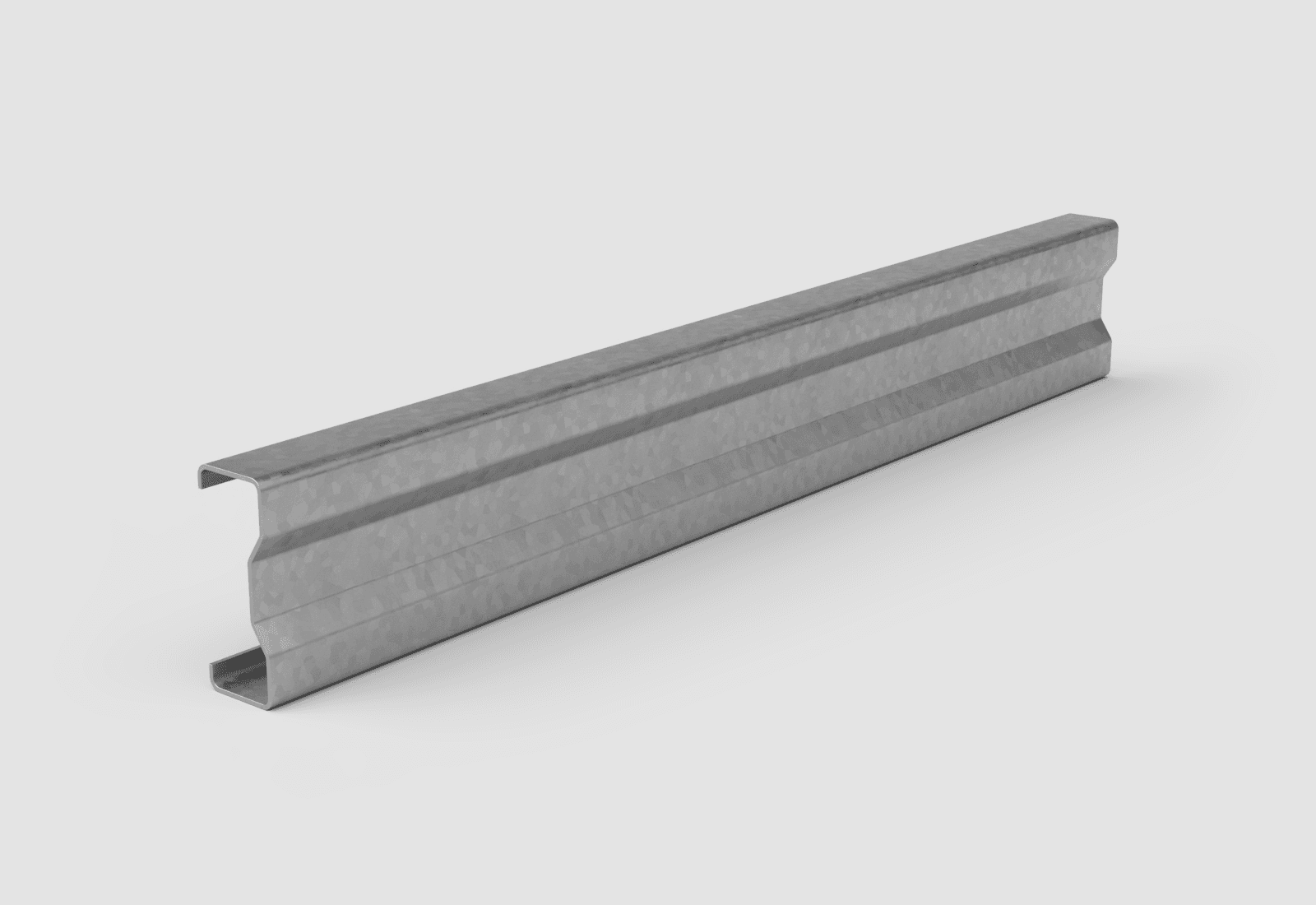
A sigma section is a roll-formed open profile named for its end-on shape, which resembles the letter sigma. Like a lipped C, it has a web, two flanges and a stiffening lip on each flange. The difference is the web: it is folded so that its middle portion steps in toward the lips, with angled folds joining it to a short outer strip at each flange. Some sections also add small grooves, or indents, to the flat parts of the web or flanges.
The folds are why a sigma section can carry more load per pound of steel than a C with a flat web of the same depth and thickness. A wide, thin flat plate in compression can buckle locally before the steel reaches its yield strength, so only part of a deep flat web works at full strength. The folds break the web into narrower flat strips that resist local buckling, so more of the section carries load. The stepped web also moves the shear center close to the web line, so a load applied through the top flange twists a sigma section less than it twists a plain C.
The folds use a little more strip, so a sigma section weighs slightly more per foot than a C of the same outside dimensions; the gain in working section is what makes it more efficient. How much more a given section carries depends on its geometry and comes from the design calculations, not from the shape name.
Sigma piles for solar foundations
A sigma pile is a heavier sigma section used as a driven post under single-axis trackers and fixed-tilt racking. The tracker bearing, bracket or rail bolts to holes and slots punched near the top of the pile.
Buyers consider sigma piles in place of light hot-rolled W-Beam posts such as W6×9, and in place of a C-pile or U-pile that falls short in bending at the wall thickness the project wants. A roll-formed section can be sized to the design instead of stepping up to the next rolled W-Beam size, and because it is formed from coil, its supply is not tied to the rolling schedule of one W-Beam size.
The engineer of record decides. The pile drawing sets the section, length, embedment, grade, coating and corrosion allowance from the loads, the geotechnical report and the pile load tests on site, and the racking or tracker manufacturer sets the hole pattern. We roll-form the section that drawing calls for. Three things to settle early:
- Driving: sigma piles go in with the same kind of pile driver as C-piles and W-Beam posts, fitted with a cap that matches the section. As with C-piles, hard driving, cobbles or rock call for test piles and review by the geotechnical engineer; where driving is very hard, the hot-rolled W-Beam is often still the pile specified.
- Punching and slotting: holes and slots for the bearing, bracket or rail are punched inline as the section is formed, to the pattern on the pile drawing. Slots give installers vertical adjustment on uneven ground without field drilling.
- Corrosion allowance and coating: both come from the soil corrosivity in the geotechnical report and the project’s design life. The allowance is a thickness of steel set aside to corrode, so where a sigma pile’s wall is thinner than the flange of the W-Beam it replaces, the same allowance takes a larger share of the section; the engineer checks the section after the allowance.
C-piles, U-piles & W-Beam piles Compare solar pile foundations
Sigma, C, Z or W-Beam?
All four carry load in solar and building frames, but they are made, named and ordered differently. A sigma, C or Z section is roll-formed and specified by its dimensions and decimal thickness; a W-Beam is a hot-rolled AISC size ordered by its designation.
| Section | How it’s made | How it’s specified | Typical uses | Notes |
|---|---|---|---|---|
| Sigma (pile, purlin or girt) | Roll-formed from coil; web folded in through its middle, lipped flanges | Depth × flange × lip × web-fold geometry × thickness | Solar piles and racking members, longer-span purlins and girts | Folds stiffen the web, so more of the section works; more bends and more complex tooling than a C |
| C-section (C-pile, C-purlin) | Roll-formed from coil; flat web, lipped or unlipped | Depth × flange × lip × thickness | Solar piles and rails, purlins, studs and racking | Flat web and fewer bends; twists under a load through its top flange unless braced |
| Z-section (Z-purlin, girt) | Roll-formed from coil; flanges face opposite ways | Depth × each flange × lip × thickness | Roof purlins and wall girts on metal buildings | Slightly unequal flanges let pieces nest and lap at supports, so a line can act as a continuous beam |
| W-Beam post (such as W6×9) | Hot-rolled wide flange shape | AISC designation: nominal depth × weight per foot | Driven solar piles and tracker posts, higher-load designs | Fixed rolled sizes, so a design steps to the next AISC size; tolerates harder driving |
Which section a project uses is a structural decision: the engineer of record sizes it, and the racking or tracker manufacturer sets the hole pattern.
Sigma purlins and girts
On steel-framed buildings, sigma sections serve as roof purlins and wall girts. The stiffened web suits longer spans, and because the shear center sits close to the web line, roof and wall loads applied through the flange twist a sigma purlin less than a plain C. Bracing, the sheeting connection and continuity over the frames are part of the structural design.
Continuity comes from sleeves, laps or splice details at the supports, designed by the engineer of record, and the punch pattern at each end of a piece has to match that detail, so send the end holes with the profile drawing. Sigma sections also go into solar carports and fixed-tilt racking as purlins, rafters and rails, punched to the racking drawing.
How to specify a sigma profile
Give us these dimensions and options and we quote the section. A sigma has more dimensions than a C, because the web folds have their own geometry, and small changes to them change both the section properties and the roll tooling.
| Item | What to give us | Why it matters |
|---|---|---|
| Overall depth | Out-to-out web depth, in inches | Sets the bending strength and how brackets and bearings fit |
| Flange width | Out-to-out for each flange | Flange width and lip together set how well the flange resists buckling |
| Lip (return) | Length out-to-out, and its angle if it isn’t 90° | The lip stiffens the flange edge |
| Web-stiffener geometry | Depth of the step, height of the middle web, angle of each fold and the inside bend radius, or a dimensioned drawing | The folds make it a sigma; they set the section properties and the tooling |
| Thickness | Decimal inches, nominal or minimum, with the gauge only as a reference | One gauge number maps to different decimals on different charts |
| Steel grade | ASTM spec and minimum yield, per your engineer of record | Sets the strength, and with the geometry, the maximum thickness the section can be formed in |
| Coating | G90 or another pre-galvanized coating, hot-dip galvanizing after fabrication, or zinc-magnesium; for piles, the corrosion allowance | Decides whether cut ends and holes are coated, and how much zinc the part carries |
| Holes and slots | A drawing or DXF of the pattern, dimensioned from one end, with hole and slot sizes | Holes are punched inline, so the pattern has to be settled before the run |
| Lengths | Each length with its piece count; piles often vary by row or block | Sets cut-to-length and bundling |
| Quantity per release | Pieces or linear feet per release, and expected annual or project volume | Sets the run length, which drives setup cost per foot |
| Delivery | ZIP codes, release schedule, bundle limits and labels by block, row or pile type | Lets releases be staged to the install sequence |
Specify decimal thickness, because one gauge number maps to different decimals. If all you have is a sample or an existing part, send it, or a photo with key dimensions, and we can match it.
Coatings for sigma piles and purlins
Driven piles are usually hot-dip galvanized after fabrication (ASTM A123), which coats every surface, cut ends, holes and slots included. The coating and any corrosion allowance are specified from the soil corrosivity in the geotechnical report and the project’s design life, so send that requirement with the pile drawing.
For purlins, girts and racking members, G90 pre-galvanized coil (ASTM A653) is cost-effective for most indoor and moderate environments. G90 means 0.90 oz of zinc per square foot of sheet, total of both sides. Pre-galvanized steel is coated before it is formed, so cut ends and punched holes are bare edges. For harsh or coastal exposure, hot-dip galvanizing after fabrication or zinc-magnesium coated steel may be the better choice, and we’ll help you match the coating to the exposure and design life.
Built for volume programs
Sigma tooling is built around one profile, so roll forming pays off on volume: production runs, repeat releases of the same section and pile programs released block by block. Longer runs bring the cost per foot down, because setup is spread across more feet of profile. A new section starts with tooling design and first articles for fit-up and testing before production runs begin.
Releases are bundled and labeled by block, row, phase or pile type and staged to your install schedule, with mill test reports and heat-number traceability on every order and galvanizing certificates where coatings apply. Laser-cut clips, brackets and plates can be cut on our 20 kW fiber laser and go on the same purchase order. We deliver across California and ship to Texas, Arizona, Nevada and nationwide, quoted per load. We also quote smaller orders when we can help.
Custom roll forming Racking & tracker parts Fiber laser cutting
What to send for a sigma profile quote
Send what you have; our estimating team reviews every request and comes back with an itemized quote. The more of this list it covers, the firmer the price:
- Pile or profile drawing (DXF, DWG, STEP or PDF), or a sample or photo with key dimensions
- Decimal thickness, steel grade and coating, with the corrosion allowance for piles
- Hole and slot pattern, as a drawing or DXF
- Lengths and the quantity at each length
- Pieces or linear feet per release, and expected annual or project volume
- Release schedule and delivery ZIP codes
- Bundling and labeling: by block, row, phase or pile type
- Documents required, such as mill test reports and galvanizing certificates
- Any laser-cut clips, brackets or plates to ship with the profiles
Roll-formed profile RFQ checklist Send a sigma profile drawing
Sigma Profiles FAQ
What is a sigma pile?
A sigma pile is a cold-formed steel post for ground-mount solar foundations, roll-formed from coil with a web folded inward through its middle, two flanges and a lip on each flange, so the section looks like the letter sigma end-on. It is driven like a W-Beam post, and the tracker bearing, bracket or rail bolts to holes and slots punched near its top. Mona Steel LLC, headquartered in Anaheim, California, roll-forms sigma sections from 20 gauge to ¼ in., including sigma piles made to your pile drawing, pre-punched, slotted, cut to length and galvanized.
Is a sigma pile an alternative to a W6×9 post?
It can be, if the engineer of record designs it in. On some ground-mount solar projects, sigma piles are proposed in place of light hot-rolled W-Beam posts such as W6×9, a W-Beam 5.90 in. deep with 3.94 in. flanges at 9 lb/ft. Whether a sigma section can replace a given W-Beam depends on the loads, the soil, the driving conditions and the corrosion allowance, and the substitute has to be on the pile drawing, usually confirmed by pile load tests on site. We roll-form the section the drawing calls for; we don’t size piles.
What is the difference between a sigma purlin and a C-purlin?
Both are roll-formed lipped sections ordered by depth, flange, lip and thickness. A C-purlin has a flat web. A sigma purlin’s web is folded inward through its middle, which stiffens it against local buckling and moves the shear center close to the web line, so a load through the top flange twists it less. For the same depth and thickness, a sigma purlin can carry more load for its weight, but its tooling is more complex. Your engineer of record picks the section.
What thickness range can you roll-form sigma sections in?
20 gauge to ¼ in. Sigma piles are usually formed toward the heavy end of that range and building purlins toward the lighter end. The maximum for a given section depends on its geometry and steel grade, so send the section and we’ll confirm it before quoting.
Can sigma piles be pre-punched and slotted?
Yes. Pre-punching, slotting, embossing and cut-to-length are inline options, so the holes and slots for the tracker bearing, bracket or rail go in as the section is formed. Send the pattern as a drawing or DXF, dimensioned from one end of the pile, with each length and its quantity. Laser-cut brackets and plates for the same piles can go on the same purchase order.
Which coatings suit sigma piles and sigma purlins?
Pre-galvanized steel to ASTM A653, such as G90; hot-dip galvanizing after fabrication to ASTM A123; and zinc-magnesium coated steel. Driven piles are usually hot-dip galvanized after fabrication, which also coats cut ends, holes and slots, with the coating and any corrosion allowance set from the geotechnical report and the design life. G90 is cost-effective for purlins and girts in most indoor and moderate environments, and we’ll help you match the coating to the exposure.
Can you match a sigma section we already use?
Yes. Send a drawing, a sample or a photo with key dimensions: the out-to-out depth, each flange and lip, the step and folds in the web, and a caliper reading of the thickness. We can match the section, or suggest changes if there is room to save weight or cost within your engineer’s design, and first articles are produced for fit-up and testing before production runs.
Do you roll-form sigma piles in volume for solar programs?
Yes. Volume work is our focus: production runs and repeat releases of the same section, with pile programs released by block or phase. Releases are bundled and labeled by block, row or pile type and staged to your install schedule, with mill test reports and heat-number traceability on every order. We deliver across California and ship to Texas, Arizona, Nevada and nationwide, quoted per load, and we also quote smaller orders when we can help.
Do you design sigma piles or provide stamped calculations?
No. Mona Steel LLC doesn’t provide pile design, stamped calculations or sealed engineering. The engineer of record designs the pile, including its section, embedment, grade, coating and corrosion allowance, usually from the geotechnical report and pile load tests, and keeps responsibility for the design. We roll-form the section on the drawing and can optimize its geometry for strength-to-weight and cost within that design.
Request a quote
Request pricing on sigma piles and sigma purlins
We take DXF, DWG and STEP files, dimensioned PDFs and bills of material. Our estimating team reviews every request and comes back with an itemized quote.
- DXF
- DWG
- STEP
- XLS/CSV